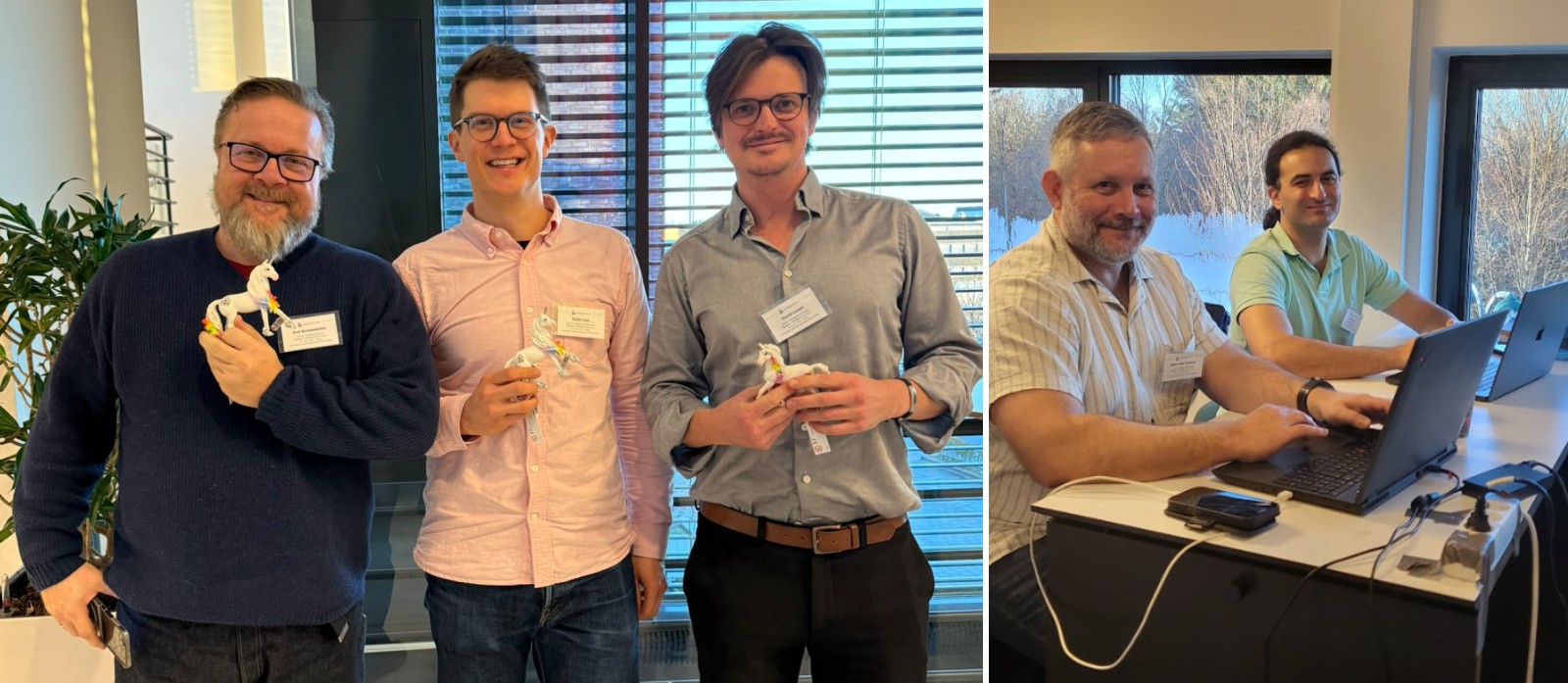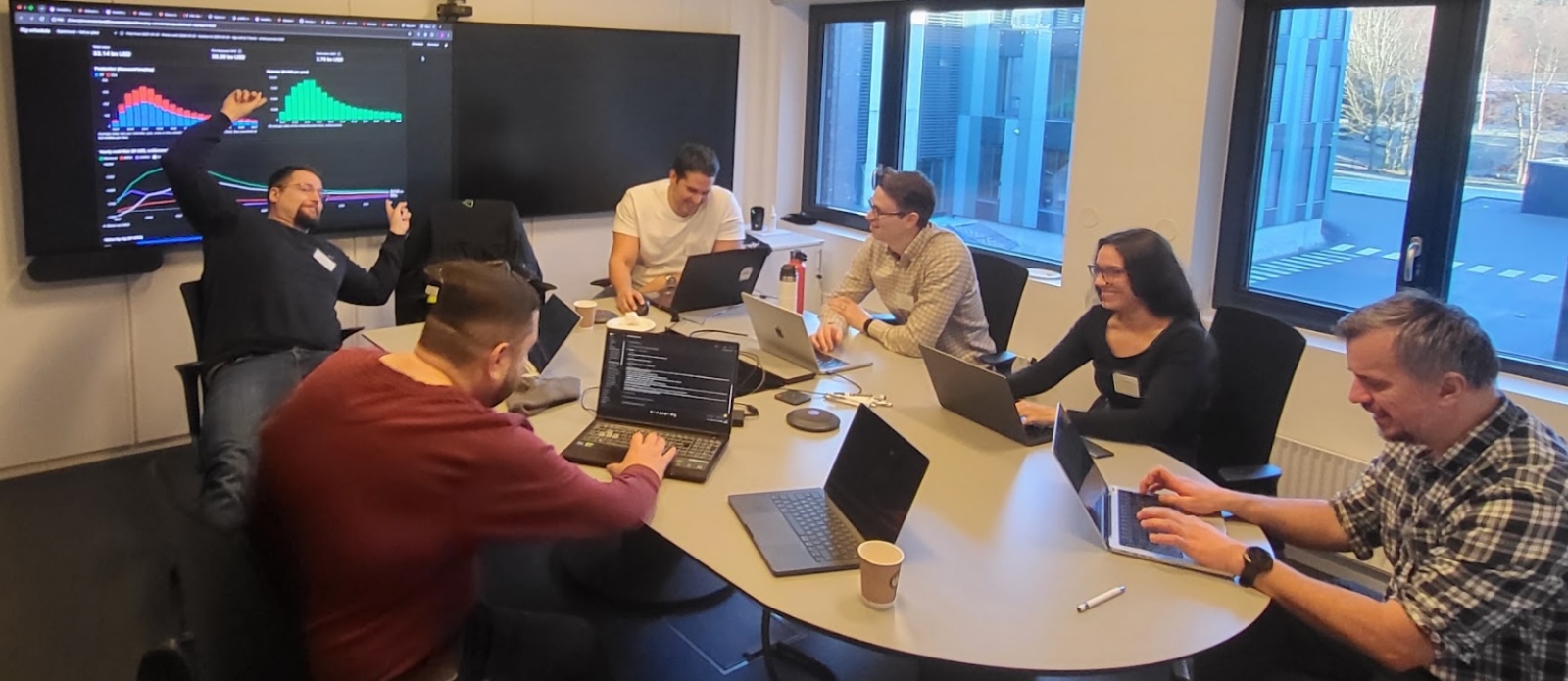
Last week, a record 17 teams of scientist–hackers and coding agents met up in Stavanger to see what they could do in 2 days. Here’s how it went.
This was the fourth hackathon hosted by the FORCE consortium:
- 2018: Machine learning theme, 50 participants working on 9 projects (report)
- 2019: Machine learning again, 65 participants working on 9 projects (report)
- 2023: Large language models, 37 participants working on 7 projects (report)
- 2026 (this one!): Vibecoding geoscience, 48 participants working on 17 projects
This latest event took place at the Havtil conference centre in Stavanger, Norway, on 19 and 20 November 2026.
As in past years, the event was organized by a small team coordinated by Peter Bormann (head of research at ConocoPhillips Norway). Peter also brews the official hackathon beers; this year a fine Saison and a Brown Ale were on offer, both excellent. These are served at the Bergeland Bydelsenter, a cosy community hall in Storhaug, on Hackathon-aften — the evening before the hackathon — where the teams and projects are sublimated from thin air in a magical process that no-one understands but mostly works.
What is a hackathon in 2026?
Given how things have gone in the world of software development in the last 12 months, I think it’s fair to say that we were all wondering how a hackathon would go, given that more than 50% of the participants were coding agents. (Just to fix the hackathon firmly in the zeitgeist: Anthropic’s IPO was on Thursday, and Levent Alpöge announced on Friday that he and Claude had probably proven the Riemann Hypotheis. Perhaps these two days were peak ‘agentic’, time will tell.)
I did my best to inspire teams with the following suggestions:
- Hackathon projects used to be massively constrained by time and skill — the constraints have changed but let’s try to still do the most important things: have fun, meeet people, and learn.
- Make something only your and your team could make — using your backgrounds, insights, skills and interests. (In other words: don’t make something anyone could make.)
- Hackathons did not used to be the place for rigour — not the place for trying finite difference, Bayesian uncertainty, linear programming solvers, or WebGL viz for the first time. Maybe now they are.
- There are so many unsolved problems in subsurface: resolution, data integration, handling ensembles, uncertainty propagation… maybe coding agents will lead to something really novel. Why not?
On the practical side, I thought we would probably have smaller teams — and we did. Only 4 of the seventeen teams had four people, 5 were pairs, and 1 person worked alone. Lots of teams is fun, but it does make the demos a challenge. We coped, just, by keeping 4-minute demos but forgoing the usual question time.
Projects
Here’s a very quick rundown of the teams and projects:
— The Jackups — All about Jack, and the first project — Simon Stavland, Bruna Atamanczuk, Julius Parulek - Jack of all Trades — More projects using Jack — Rhuan Samary Barreto, Olav Angell, Omar Kotb - CHAP — Agentic porosity transform workflow — Umed Kakhkhorov, Alex Dunbar - Latent Exploration — Exploring the seismic embedding space — David Wade, Trond Kirkevik, Jan Ove Knutsen - Resist — Resistivity algorithms and inversion tools for Ekofisk — Dylan Loss, David Larsen, Ove Kuvåssæter - Dirso — Exploring Sodir’s open data — Andres Hatløy, Harald Sund, Øystein Leiknes Nag, Kjersti Evensen - WellGraph — Knowledge graph of 5,326 Norwegian end-of-well reports — Jie Cao, Faiz Hirzi Ridhadin, Ketil Nummedal - AVO Busters — Semi-automatic AVO for lithology prediction — Jørgen Jacobsen Vaet, Nam Pham, Alexandre Penha - Rock Echo — Educational analogue finder and some games — Frode Aarstad, Zana Pepaj Kajolli, Akram ourir - MEGA2 — Running reservoir simulations — Alexander Kovalevich, Abdul Saboor Khan - Reservoir Dogs — Evidence-based well analysis using reports and search — Varun Sharman, Ashay Singh - Truebore — Search records from 1,970 Norwegian exploration wells — Nikita Alexeev - Well Modelled Benchmark — Predict missing curves; benchmark gap-filling models — Erling Hugo Jensen, Dmitry Rudshin, Vetle Nevland, Karl Simpson - Bias Busters Decision Modelers — Reference class forecasting for field development decisions — Eric Nesvold, Mathias Chakib Bellout - WellcatGame — Drill-or-drop well decision game from real Norwegian Shelf history — Hoang Nguyen, Frank Haugen - Team Underpressure — Pore-pressure and fracture-gradient analysis with uncertainty — Stefan Catalin Craciun, Ashley Russel, Aashish Karki, Victor Escobar - Team Volcano — Hunting oil seeps with SAR — Andrew Moyle, Kamila Kulmambetova, Håkon Nese, Erik Berthelsen
Rather than go into a lot of detail, I will instead leave you with the video from the demo session. If you watch it, you will notice that we did not optimize for this recording 😀 But hopefully you can get the jist of what the projects were about and what they achieved.
Congratulations to all the teams for your successes — and for being bold enough to show up as the all-important humans in the loops. Remember to take time to reflect on what you learned and let’s get to those unsolved problems together in 2027! 🚀
Credits
Although Peter is the chief orchestrator of these events, he is assisted by a community of subagents. Here’s a probably incomplete list of who was involved this year:
- **Ciprian-Teodor Panaitescu (Equinor) for just generally staying on top of basically everything.
- Lukas Mosser, (AkerBP) for the .
- Bjørn Atle Vorland and Majid Hajian (Microsoft) for the in-event Azure and Foundry support.
- Sokkeldirektoratet, especially Linn Smerud and those involved in FORCE.
- There’s just enough time between hackathons for Peter to forget how amateurishly I emcee, but I love doing it so the arrangement suits both of us. Thanks Peter!